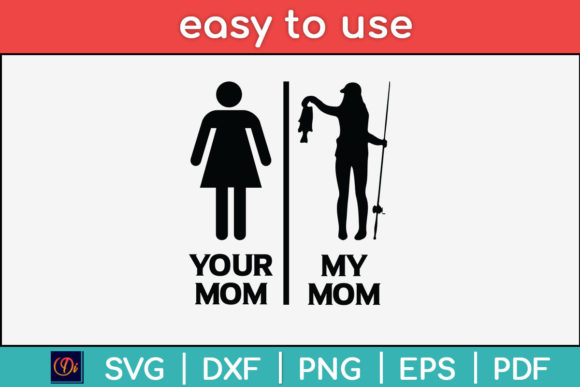
Your Mom My Mom Svg File: An Embroidery Review
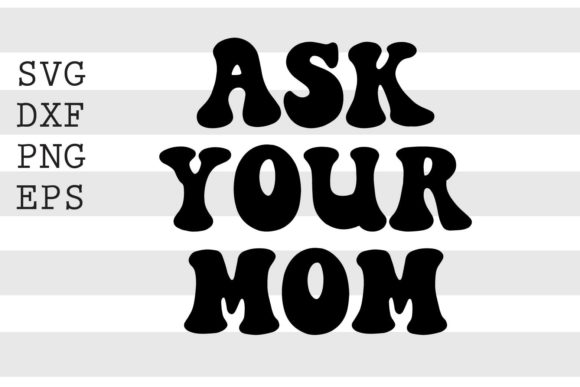
As a professional designer who bridges the gap between digital graphics and tactile needlework, I approach every new file with a specific question: will this actually stitch out well? When evaluating the Your Mom My Mom Svg File, my first impression is that it carries a distinct, playful nostalgia. While primarily marketed as a print cut file compatible with Cricut and Silhouette machines for vinyl and paper crafts, its aesthetic has significant potential for the embroidery community. The design evokes a sense of shared heritage and familial connection, making it an emotionally resonant choice for personalized gifts and boutique apparel. However, translating a vector graphic intended for cutting into a machine embroidery design requires careful consideration of stitch physics, fabric interaction, and visual hierarchy.
Translating Vector Lines to Stitched Reality
The transition from a digital SVG to a finished embroidered product is never automatic. In reviewing the Your Mom My Mom Svg File, I look at the line weight and negative space. For embroidery, clean lines are essential. If the original graphic features varying line weights or distressed textures common in print graphics, these must be interpreted deliberately during digitization. A running stitch works beautifully for delicate, handwritten-style lettering, preserving the organic feel of the phrase. Conversely, if the design includes bolder elements, a satin stitch might be necessary to create definition, though this increases stitch density significantly.
I recently tested this concept while preparing a custom sweatshirt embroidery project for a Mother’s Day capsule collection. The goal was to create a garment that felt vintage yet modern. Using the Your Mom My Mom Svg File as the foundational art, I had to adjust the spacing between letters to accommodate thread thickness. What looks airy on a screen can become a dense, puckered mess on fleece if the kerning isn't adjusted for the physical medium. The result, after proper digitizing adjustments, was a soft, textured design that maintained the graphic's original charm without compromising the integrity of the heavy cotton fleece.
Best Applications for Apparel and Gifts
This design naturally lends itself to projects centered around family, memory, and connection. As an Etsy seller or small shop owner, you should consider where this sentiment adds the most value. It is exceptionally strong for:
- Custom Apparel: Sweatshirts and t-shirts are the primary canvas. The phrase works best as a left-chest placement or a centered back print. For t-shirt embroidery, ensure the design size is scaled down to prevent fabric distortion on lighter knits.
- Tote Bag Design: Canvas totes provide a stable surface for embroidery. The Your Mom My Mom Svg File translates well here because the sturdy fabric can support higher stitch counts without warping. This makes for an excellent craft business item or eco-friendly gift.
- Baby Embroidery: When adapting this for baby clothes or blankets, simplicity is key. Reduce the complexity to minimize bulk against sensitive skin. A single-color running stitch version often looks more refined and comfortable than a multi-color fill stitch variation.
- Holiday Embroidery: Beyond Mother’s Day, this design fits perfectly into Christmas matching pajama sets or family reunion merchandise. Its universal phrasing allows it to transcend specific holidays, giving your digital embroidery file year-round relevance.
Navigating Fabric Challenges and Technical Limits
Not every surface is friendly to this specific aesthetic. As an experienced reviewer, I must highlight where caution is needed. The Your Mom My Mom Svg File, depending on how it is ultimately digitized, may struggle on highly textured fabrics like terry cloth or boucle unless a topping stabilizer is used effectively. The fine details of the lettering can get lost in the pile of a towel or blanket.
Stretchy fabrics present another hurdle. If you are planning sweatshirt embroidery or working with performance knits, the tension of the hoop combined with the pull of the stitches can distort the text. Always use a cut-away stabilizer for stretchy garments to maintain the shape of the letters over time. For curved surfaces like caps, evaluate the vertical height of the design. Arched text often requires re-digitizing specifically for cap hoops to prevent flagging or misalignment. Never assume a flat-hoop version of this embroidery file will stitch correctly on a hat without modification.
Dark fabrics also demand attention. If the design relies on thin lines, they may disappear against navy or black material. In these cases, increasing the stitch width or adding a subtle outline can improve visibility and contrast, ensuring the handmade product remains legible and impactful.
Commercial Viability and Brand Consistency
For creative entrepreneurs and commercial embroidery businesses, consistency builds trust. When using the Your Mom My Mom Svg File across multiple products, establish a standard for how it is rendered. Will it always be a single color? Will it always be paired with a specific font style for names? Creating a cohesive look helps customers recognize your brand instantly, whether they are viewing a printable mockup online or seeing the finished product at a craft fair.
From a licensing perspective, clarity is non-negotiable. Since this is sold as a graphics asset for cutting machines, you must verify the commercial license terms regarding embroidery. Some designers permit the use of their vectors for creating physical embroidered goods but prohibit reselling the digitized embroidery file itself. Always confirm these details before listing a digital embroidery file or mass-producing items. Respecting intellectual property protects your business reputation and ensures you are operating ethically within the maker community.
Essential Pre-Stitch Checklist for Makers
Before committing this design to a final product, run through this practical evaluation process to ensure professional results:
- Test on Scrap Fabric: Never stitch directly onto a sellable item first. Use a scrap of the exact fabric and stabilizer combination you plan to use. Check for puckering, registration errors, and thread breaks.
- Evaluate Thread Colors: Test the design in both high-contrast and low-contrast thread colors. A design that pops in white thread on navy might look muddy in grey on heather charcoal. Visual appeal drives sales.
- Check Stitch Density: Feel the back of your test stitch-out. If it is stiff or bulletproof, reduce the density. Comfort is paramount for wearable custom apparel.
- Verify Hoop Size Compatibility: Ensure the design fits comfortably within your machine’s maximum stitching area with adequate margin for the hoop grip. Crowding the edges leads to alignment failures.
- Mockup Realistically: When creating listings, use mockups that show texture and dimension. Flat vector previews can be misleading for embroidery buyers. Show them what the actual stitched texture looks like to manage expectations and reduce returns.
Final Thoughts on Design Adaptation
The Your Mom My Mom Svg File offers a wonderful foundation for meaningful, text-based embroidery projects. Its strength lies in its emotional resonance and versatility across various mediums, from nursery decor to adult fashion. However, success depends entirely on the maker’s willingness to adapt the graphic for the physical realities of thread and fabric. By respecting stitch mechanics, choosing appropriate applications, and validating technical specs through testing, you can transform this digital asset into a high-value handmade product that delights customers and stands the test of wear. Whether you are an applique design specialist or a minimalist stitcher, this phrase provides ample room for creative interpretation that honors both the original art and the craft of embroidery.